
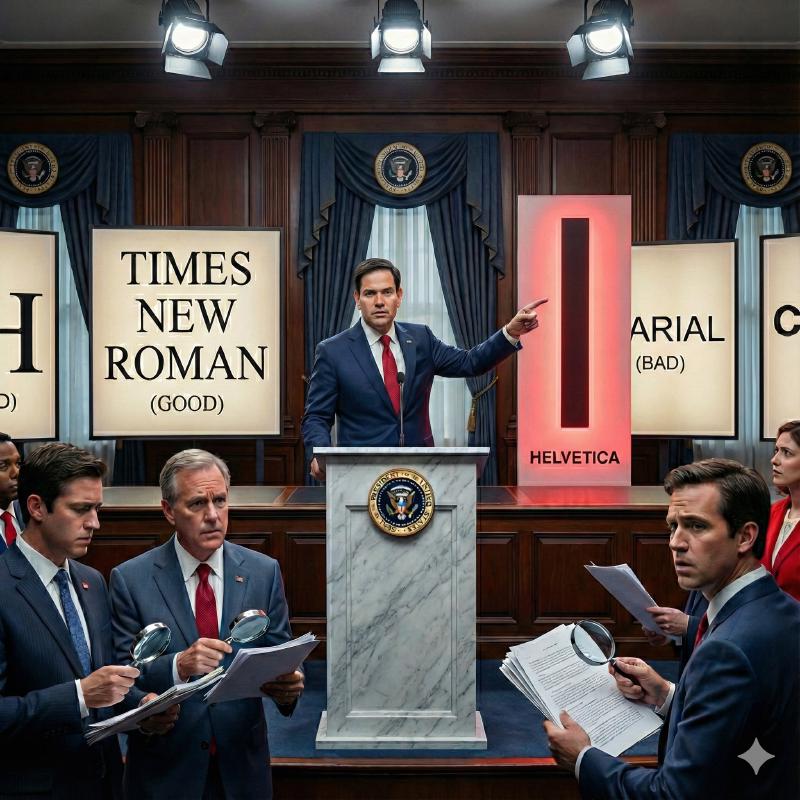
Rubio's Serif Restoration Act: "If It Doesn't Have Feet, How Do You Know Where It Stands?"
WASHINGTON, D.C. — Secretary of State Marco Rubio just announced the “Serif Restoration Act,” sending foreign ministers scrambling to their style guides and graphic designers updating their LinkedIn profiles.
The new rule is simple but brutal: Times New Roman is now the only legal font for U.S. diplomacy. Any nation caught using “soul-less” sans-serifs like Arial, Helvetica, or the now-contraband Calibri faces immediate, crippling economic sanctions.
“This isn’t just about aesthetics,” Rubio declared from a podium reinforced with marble columns, his voice sharp with disgust. “A letter without feet is a letter that cannot be trusted. It floats. It wavers. It hides its true nature. The United States will no longer conduct business with nations that let their letters lie about who they are.”
The Typography Inquisition Begins
The crackdown has been swift. The new “Serif Security Council” has already seized a cargo ship of ink cartridges bound for “Sans-Serif States,” labeling them “supplies for the stick-figures.” The State Department has designated Switzerland—home of the neutral Helvetica—as a “Typography Concern of Particular Interest,” with Rubio reportedly expressing deep concern that U.S. citizens might be hiding illicit sans-serif fonts in Swiss bank accounts. Last Thursday, Rubio’s security team raided the State Department basement and confiscated twelve iPads, all set to Helvetica Neue. Two diplomats were placed on administrative leave.
State Department insiders report that Rubio personally shreds any memo without “proper terminal strokes,” muttering about “ambiguity” and “deception.”
“He’s obsessed,” whispered a source close to the Secretary, communicating via a self-destructing serif-free PDF. “I saw him fire an intern for using a sans-serif ‘I’ on a post-it note.”
The 1982 Incident
Yesterday’s press briefing went off the rails when a reporter from the Washington Post challenged the Secretary on the odd specificity of his crusade.
“Mr. Secretary,” the reporter asked, “critics say this policy is irrational. Why this specific hatred for sans-serif fonts? Is there a personal reason?”
A thin, humorless smile stretched across Rubio’s face. He leaned into the microphone, ignoring his frantic aides as the room went dead silent.
“You want to know about 1982, don’t you?”
“1982. The Miami-Dade Regional Spelling Bee. I was a finalist. The word was ‘Illimitable.’ The moderator held up the card. It was printed… in Helvetica.”
He slammed his fist on the podium.
“I couldn’t tell! The uppercase ‘I’ and the lowercase ’l’… they looked exactly the same! Three vertical lines! Just three sticks mocking me! I guessed ‘L-l-l-imitable.’ The buzzer sounded. I lost. I lost because that font was too cowardly to put feet on its letters!”
Rubio was ushered off stage by aides, still shouting.
“It has to have feet! If it doesn’t have feet, how do you know where it stands?!”
politics foreign-policy typography satire