
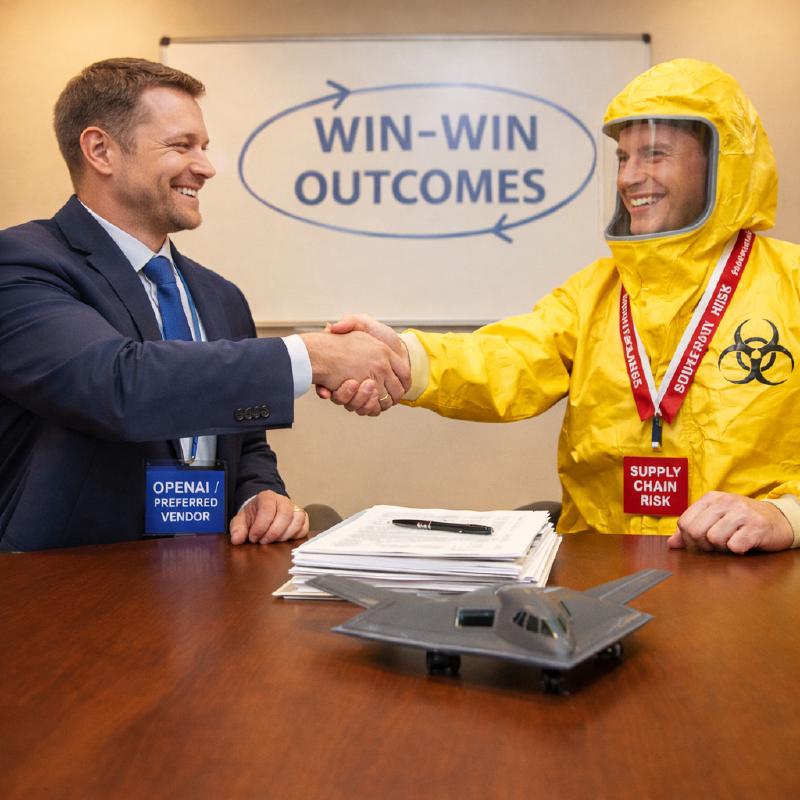
Defense Department Completes AI Vendor Assessment, Awards OpenAI $1.8 Billion Contract
WASHINGTON, D.C. — The Pentagon announced Tuesday it has awarded OpenAI a $1.8 billion defense contract for battlefield decision-support tools, a move officials described as the natural conclusion of an eight-month competitive review process that also resulted in Anthropic being designated a national security risk, Operation Epic Fury, and the death of Iran’s Supreme Leader.
The Defense Department’s Directorate of Wartime AI Acquisition released a 47-page vendor assessment Wednesday confirming that OpenAI’s GPT-based models “met or exceeded all performance benchmarks,” while Anthropic’s Claude “raised supply chain concerns requiring further action.” A separate annex, classification level SECRET//REL TO FVEY, details the 847 additional actions taken during the same review window.
“This was a rigorous, by-the-book procurement,” said Lt. Gen. Harold Pruitt, Deputy Undersecretary for Defense Innovation, at a press conference. “We evaluated vendors on capability, security posture, integration complexity, and total cost of competition elimination. Only one provider checked every box.”
Asked whether the simultaneous Anthropic security designation and the Iran strike package were connected to the procurement timeline, Pruitt said the question reflected “a fundamental misunderstanding of how contracting works.”
During a Thursday appearance on CNBC, President Trump described the week’s events as tracking ahead of internal milestones. “We’re well ahead of schedule,” he said, referencing a laminated card he described as “the scorecard.” When anchor Sara Eisen asked which schedule he meant, Trump said “all of them.”
The White House later clarified that the laminated card referred to both the AI procurement roadmap and what the National Security Council internally calls the “Iran Deliverables Timeline,” though officials emphasized these were “two completely separate documents that happened to have identical completion dates.”
Anthropic declined to comment on its designation as a supply chain risk. A spokesperson said only that Anthropic “remains committed to responsible AI development” and that its executive team “is monitoring the situation closely from an undisclosed location.”
OpenAI CEO Sam Altman praised the Pentagon’s decision in a statement calling it “a historic alignment between American innovation and American strength.” Altman, who was present at the Pentagon for an unannounced briefing the previous Thursday, did not address questions about the timing.
“This is exactly why we’ve been pushing for a unified wartime acquisition framework,” said Ranking Member Rep. Diane Okafor (D-Ill.). “You cannot run a competitive AI vendor assessment and a theater-level strike package on separate timelines. Someone was always going to miss a milestone.”
Senate Republicans largely praised the efficiency. “This administration doesn’t waste time,” said Sen. Bart Cresswell (R-Ky.), speaking from the Senate floor. “Previous administrations would have spent three years on an RFP. We wrapped up the whole vendor situation in one week. That’s what streamlining looks like.”
The Pentagon’s vendor assessment framework has since been adopted as a case study by the Defense Acquisition University under the title “Accelerated Competition Resolution: A Modern Procurement Playbook.” Module Three covers “Non-Traditional Deselection Methodologies.” The annex detailing the 847 additional actions is listed as supplementary reading.
At press time, Anthropic had submitted a formal protest to the Government Accountability Office regarding the procurement decision. The GAO confirmed receipt of the filing and noted that standard review takes 100 business days, during which the contract award remains in effect.
satire technology politics military ai